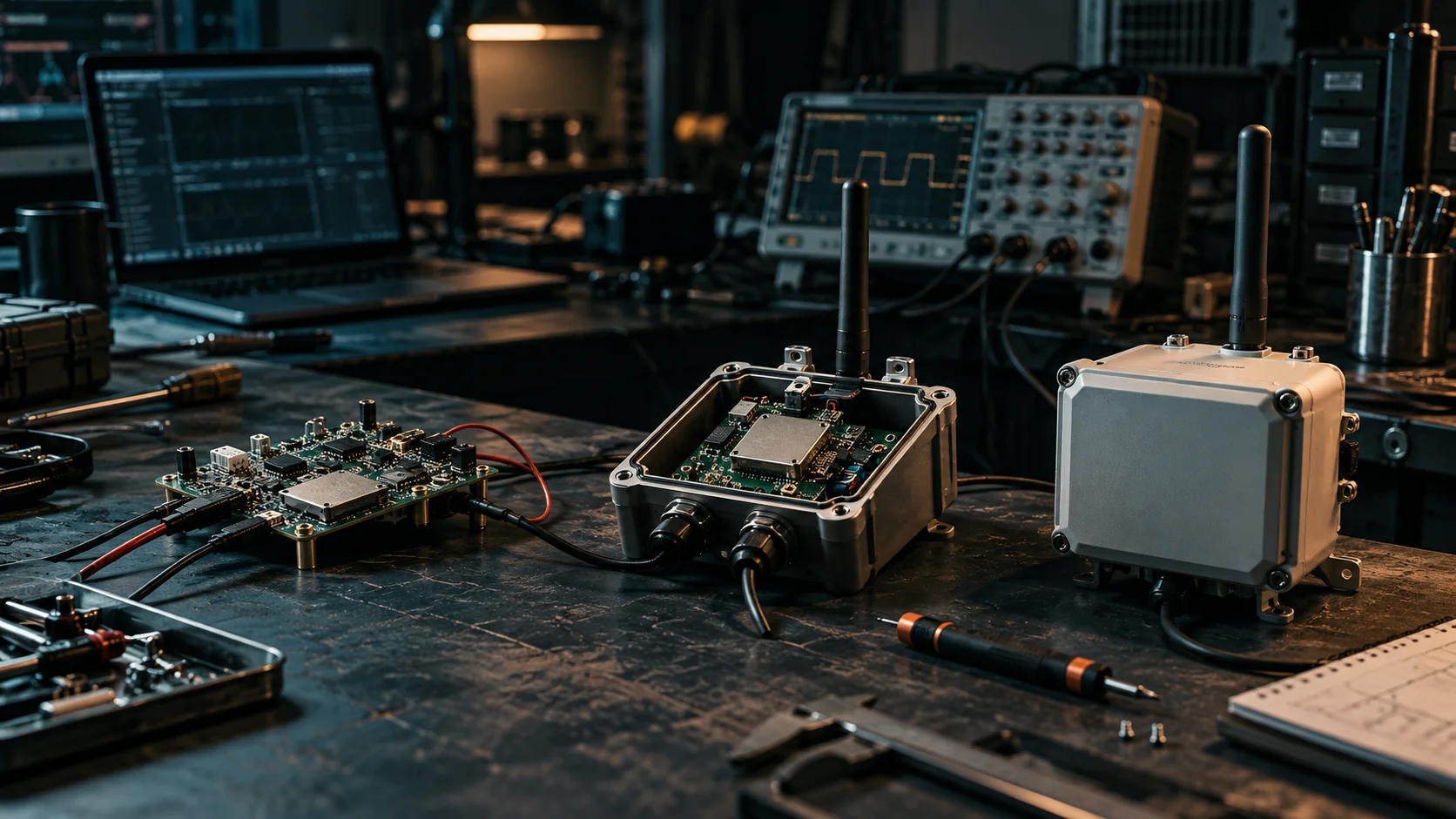
A prototype proves that a device can work. It does not prove that the same design can be manufactured repeatedly, commissioned without shared secrets, left offline for a day, updated after deployment, diagnosed remotely, or recovered after a bad release.
That distinction is what production readiness should capture. It is not a ceremonial moment when the dev board is replaced by a custom PCB. It is an evidence threshold for the complete system around the device.
A production-ready device does not need to survive every imaginable failure. It needs a defined operating envelope, observable state, controlled change, and a credible recovery path when reality leaves that envelope.
The map below separates three decisions that are often collapsed into one launch milestone. Each transition requires stronger evidence because the next state increases exposure and operational consequence.
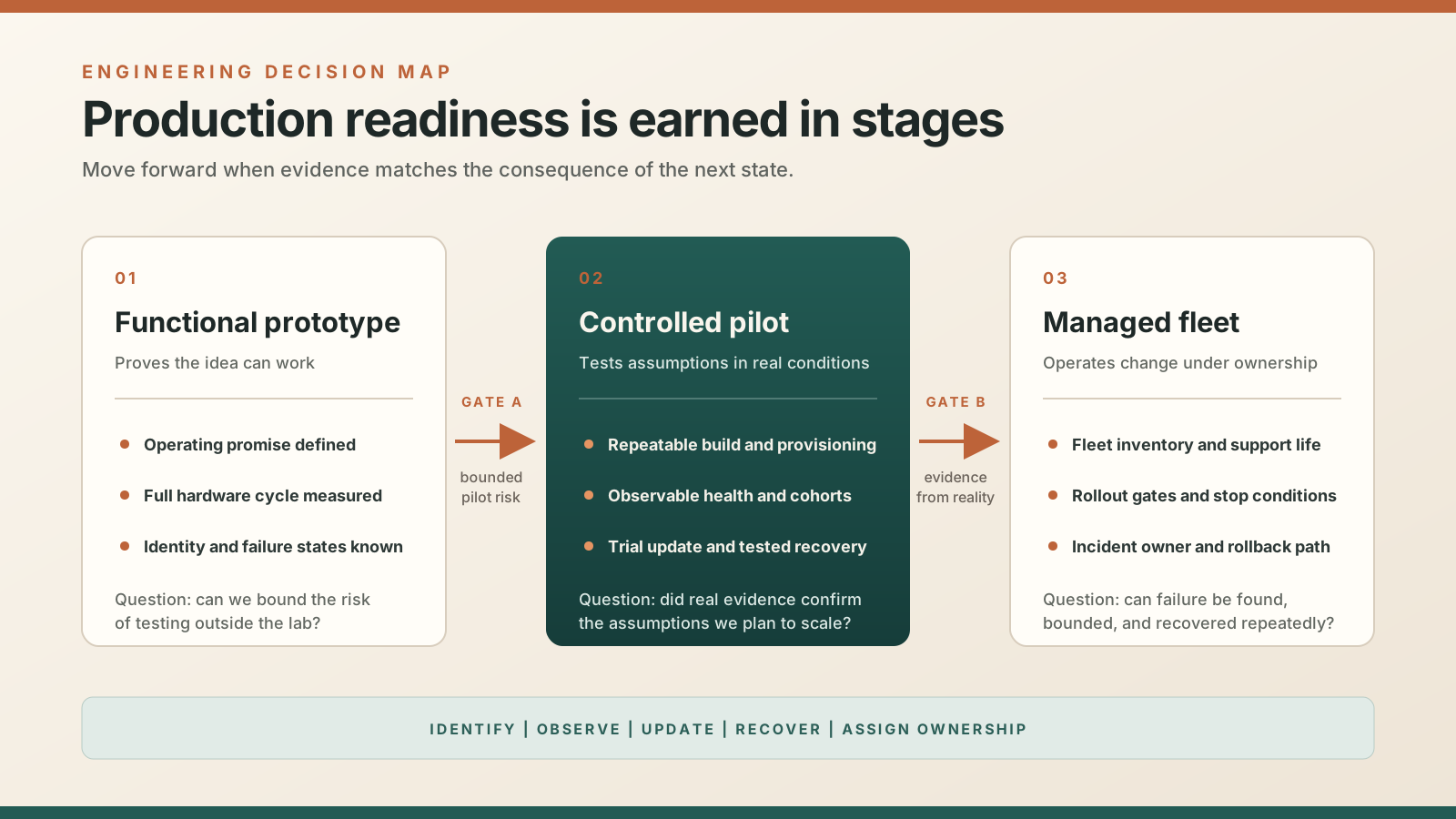
The arrows are gates, not calendar dates. A team moves forward when the evidence is sufficient and retains a path back when the next environment disproves an assumption.
Start with the operating promise
Before choosing tests, define what the product is promising. Where will it operate? How long may it be offline? Which measurements may be lost? What happens when time is wrong, storage is full, a certificate expires, or an update boots but damages radio behavior? Who owns the incident after shipment?
These questions turn “reliable” from an adjective into a set of conditions. A mains-powered gateway in a serviced building and a battery sensor on remote infrastructure do not need the same evidence. Neither should inherit a generic checklist without a threat model, service model, and failure budget.
The useful output is a short operating contract:
- expected environment, power source, connectivity, and service life;
- data that must be preserved, data that may be aggregated, and data that may be dropped;
- permitted remote actions and who may authorize them;
- maximum acceptable outage and recovery behavior;
- supported software lifetime and ownership of field incidents.
Without that contract, teams tend to optimize what is easiest to demonstrate: nominal current, successful connection, one clean update, and a dashboard receiving data. Production failures live in the conditions the demonstration omitted.
Gate 1: the hardware is repeatable, not merely functional
Moving away from a development board changes more than form factor. The product now owns its power path, component tolerances, antenna environment, connectors, protection, test access, thermal behavior, enclosure interactions, and assembly variation.
The evidence required before a controlled pilot should include measurements across complete operating cycles, not only steady-state readings. Radio transmission, sensor warm-up, flash operations, inference, and actuator startup can create short peaks hidden by an average-current estimate. Brownout recovery deserves a test of its own because a device that restarts into the same failing operation can become a reset loop rather than a recovered system.
A practical hardware gate asks:
- Can each unit be programmed, identified, and tested without manual improvisation?
- Are sleep current, wake peaks, regulator losses, and thermal limits measured on representative hardware?
- Are antenna performance and radio coexistence tested inside the intended enclosure?
- Are test points and manufacturing diagnostics available for the failures the factory must distinguish?
- Are component substitutions and tolerance limits documented rather than silently accepted?
- Does loss and restoration of power lead to a known state?
Passing this gate does not prove long-term reliability. It shows that the design can be reproduced and that its basic limits are measured rather than assumed.
Gate 2: every device has an identity and a lifecycle
A fleet cannot be governed if devices are indistinguishable or depend on one permanent shared credential. Identity should connect a physical unit, its manufacturing record, its current owner, its software state, and the authority it has been granted.
NISTIR 8259A describes a core baseline that includes device identification, configuration, data protection, logical access to interfaces, software update, and cybersecurity-state awareness. These capability areas are useful because they force readiness to extend beyond encrypted transport. A device also needs to be recognized, configured through controlled interfaces, updated by authorized software, and able to expose security-relevant state.
Provisioning therefore needs a lifecycle, not just a factory script. The design should explain how bootstrap authority is limited, how operational credentials are established, how secrets are rotated, how ownership changes, how a compromised unit is revoked, and what recovery is possible without restoring an unsafe universal default.
Secure boot can strengthen this chain by allowing the device to verify that an image is authorized before execution. It does not decide who protects the signing key, how keys are rotated, what happens when trust must be replaced, or how a fleet responds to a signing incident. Those are product and operational responsibilities.
Gate 3: firmware fails into a diagnosable state
Firmware readiness is not the absence of known crashes. It is the ability to distinguish states and react predictably when one becomes unhealthy.
At minimum, a fielded device should expose an immutable hardware identity, firmware version, configuration version, boot reason, reset history, and enough bounded diagnostics to separate power, connectivity, storage, peripheral, and application failures. A watchdog can restore execution, but it is not a diagnosis. Repeated watchdog resets without retained reason or backoff can hide the problem while consuming power and network capacity.
Configuration also needs versioning and validation. A syntactically valid configuration can still be incompatible with the current firmware or hardware revision. The device should be able to reject it, retain a known-good value, or enter a limited recovery state. “Accept JSON and reboot” is not a safe configuration model.
Useful failure tests include corrupted state, full local storage, missing peripherals, clock jumps, repeated resets, exhausted credentials, incompatible configuration, and loss of power during persistent writes. The goal is not to create one heroic recovery routine. It is to make failure classes visible and bounded.
Gate 4: connectivity survives absence and return
A connected device must be designed for disconnection. The relevant question is not whether it reconnects during a desk test, but what happens to state while it is absent and what load it creates when connectivity returns.
The device needs an explicit policy for buffering, timestamps, ordering, duplicate delivery, overflow, retry, and backoff. Event time should not be confused with transmission time. Messages that may be retried need stable identity or idempotent processing. A local queue needs a bound and a defined overflow decision; otherwise “store everything” eventually becomes an uncontrolled storage failure.
Recovery also has to be safe at fleet scale. If thousands of devices reconnect after the same outage, identical retry timing can turn recovery into a second incident. Jitter, exponential backoff, server-side admission control, and staggered work are operational features, not networking polish.
Before a pilot, test a long outage and a constrained reconnection. Before scale, test many devices returning together, including old firmware and partially full buffers.
Gate 5: an update is a controlled state transition
“The device supports OTA” often means that it can download and write a new binary. Production readiness begins after that demonstration.
An update path must answer five separate questions:
1. Is the artifact authentic and compatible with this hardware and current state?
2. Can download and installation survive interruption?
3. Can the new image boot without destroying the previous recovery path?
4. What health evidence confirms that the new version may become permanent?
5. What stops or reverses the rollout when the evidence is bad?
ESP-IDF provides one concrete model. With application rollback enabled, a newly booted image can remain pending verification until the application marks itself valid. It can instead be marked invalid and reboot to the previous working application, while an unexpected reset before confirmation can cause the unconfirmed image to be aborted. MCUboot documents a similar idea through test swaps, image confirmation, and revert.
The important pattern is not a particular API. It is the separation of installation, trial boot, health confirmation, and permanence. A successful HTTP response or checksum verifies only part of that path. Signed images, secure boot, anti-rollback, partition design, application health, cohort rollout, and operational stop conditions solve different problems.
A production rollout should begin with representative cohorts, advance through explicit gates, and pause automatically on defined health regressions. Rollback must be exercised under power interruption and incompatible configuration before the team needs it during an incident.
Gate 6: observability is useful and bounded
A device cannot be operated from a dashboard that reports only “last seen.” Teams need to distinguish fleet, device, software, connectivity, and application state. They also need to do so without treating continuous raw-data collection as the default answer.
Useful operational signals commonly include:
- hardware and firmware revision;
- configuration version and deployment cohort;
- boot reason, reset counters, and update state;
- queue depth, storage pressure, connection attempts, and delivery failures;
- power or thermal warnings relevant to the device class;
- a small set of application health indicators tied to the operating promise.
Cybersecurity-state awareness appears in the NISTIR 8259A baseline, but state awareness only helps when someone owns the response. Alert thresholds, retention, escalation, and privacy boundaries need to be designed with the telemetry itself.
The fleet should also be enumerable. Operators need to know which units exist, which versions they run, which cohort they belong to, and which are outside the supported state. If that inventory requires reconstructing facts from broker logs during an incident, it is not an operational inventory.
Gate 7: the organization can support what it ships
Production readiness extends beyond device capabilities. NISTIR 8259B identifies non-technical supporting capabilities including documentation, receiving information and queries, disseminating information, and education and awareness. That is a useful reminder that a secure update feature without a vulnerability intake process, customer communication path, or supported-lifetime policy is incomplete.
A team should know:
- where manufacturing and field records are retained;
- how customers and researchers report a vulnerability or defect;
- who can stop a rollout and who can authorize recovery;
- how long software and security support are provided;
- how operators learn about changed behavior and required action;
- how end-of-support and decommissioning remove credentials and user data.
ETSI EN 303 645 provides a consumer-IoT baseline covering areas such as credentials, vulnerability reporting, updates, secure storage and communication, exposed attack surface, integrity, telemetry examination, deletion of user data, and input validation. It is not a universal certification checklist for every device class, but it is a useful challenge to teams that have treated security as only transport encryption.
Use two evidence gates, not one launch decision
A controlled pilot and a managed fleet should not require identical evidence. The pilot exists partly to test assumptions, but it should not test them without boundaries.
Before a pilot, require at least:
- repeatable programming, identity, and end-of-line checks;
- measured power, thermal, enclosure, and radio behavior on representative units;
- bounded offline storage and tested reconnect behavior;
- authenticated update with a retained recovery path;
- versioned configuration and minimum diagnostic state;
- named owners for incidents, credentials, updates, and support.
Before expanding the fleet, require evidence from the pilot:
- failure and reset patterns are understood rather than merely low;
- telemetry volume, retention, and alerting remain operationally affordable;
- cohort rollout, pause, and rollback work with real devices;
- manufacturing variation and field environment stay inside measured limits;
- support documentation and escalation paths were actually usable;
- unsupported device states can be found and remediated.
The decision should be recorded with its exceptions. A known limitation with an owner, boundary, and corrective plan is different from an assumption nobody measured.
Production-ready means recoverable under ownership
No checklist can prove that an IoT product will never fail. The stronger standard is that the team understands the product's operating promise, can observe when the promise is breaking, controls who may change deployed devices, and has tested paths back to a known state.
That is why production readiness belongs to the whole system. Hardware repeatability without fleet identity is incomplete. Secure boot without key lifecycle is incomplete. OTA without health confirmation and rollback is incomplete. Telemetry without ownership is noise. Documentation without a supported recovery mechanism is reassurance without control.
A prototype asks whether the idea can work. A controlled pilot asks whether the assumptions survive contact with a real environment. A production fleet asks whether failures can be detected, bounded, and recovered repeatedly. The device is ready to move forward only when the evidence matches the consequence of the next step.